LockFlare

A cache that survives losing the box it runs on.

Redis or Valkey installed bound to the box and passworded from the first minute, then a Sentinel set built by dropping servers into a box: one primary, replicas that copy it, a sentinel beside each. When enough of them agree the primary is gone, they promote a replica themselves and every Sentinel-aware app follows within seconds. Lens builds it and gets out of the way.

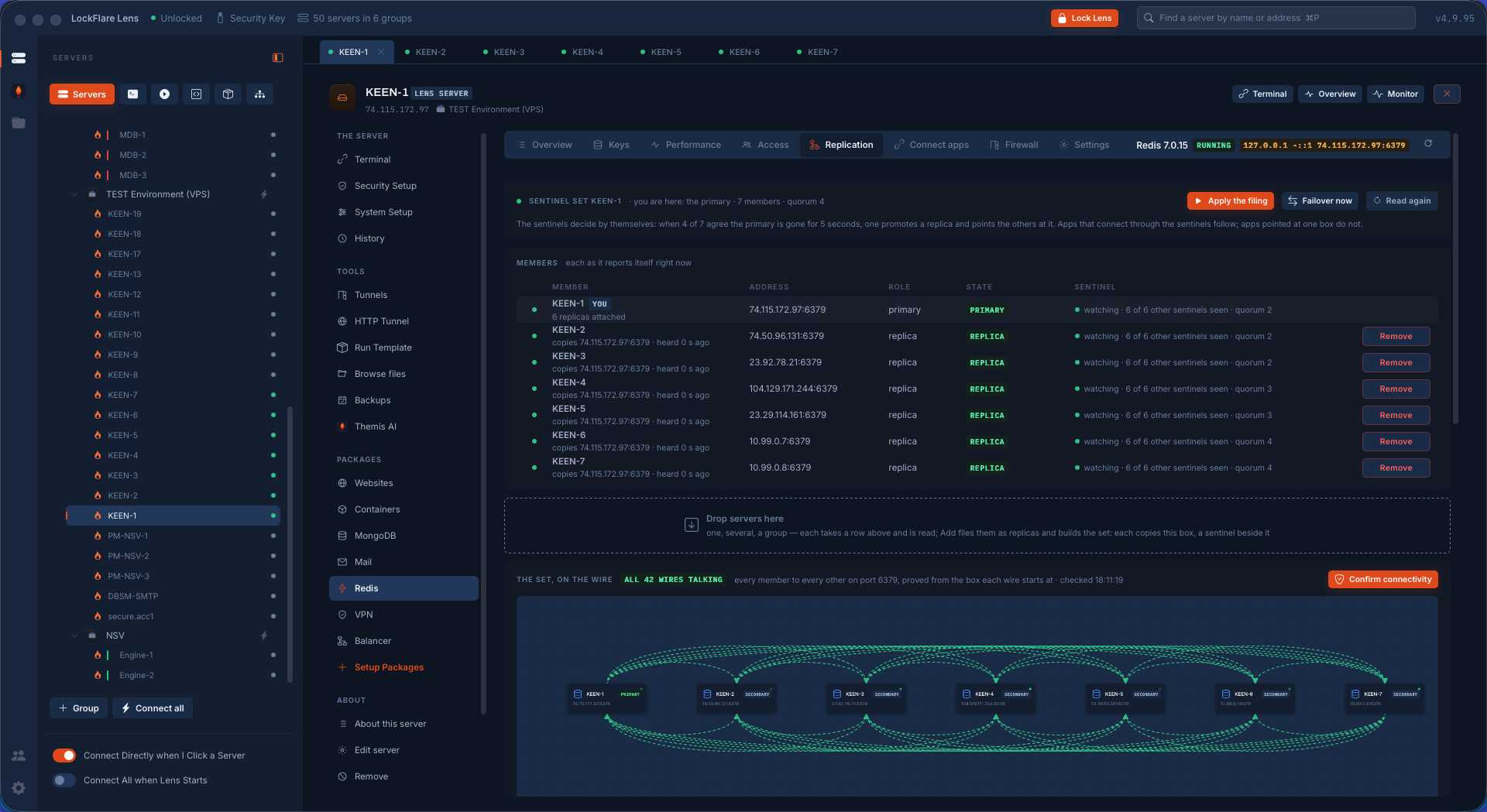
A seven-member Redis Sentinel set in LockFlare Lens: every member with its role and state, and all 42 wires between them proved from the box each one starts at
Seven members, quorum four, and all 42 wires proved from the box each one starts at.

Installed the way it should have shipped

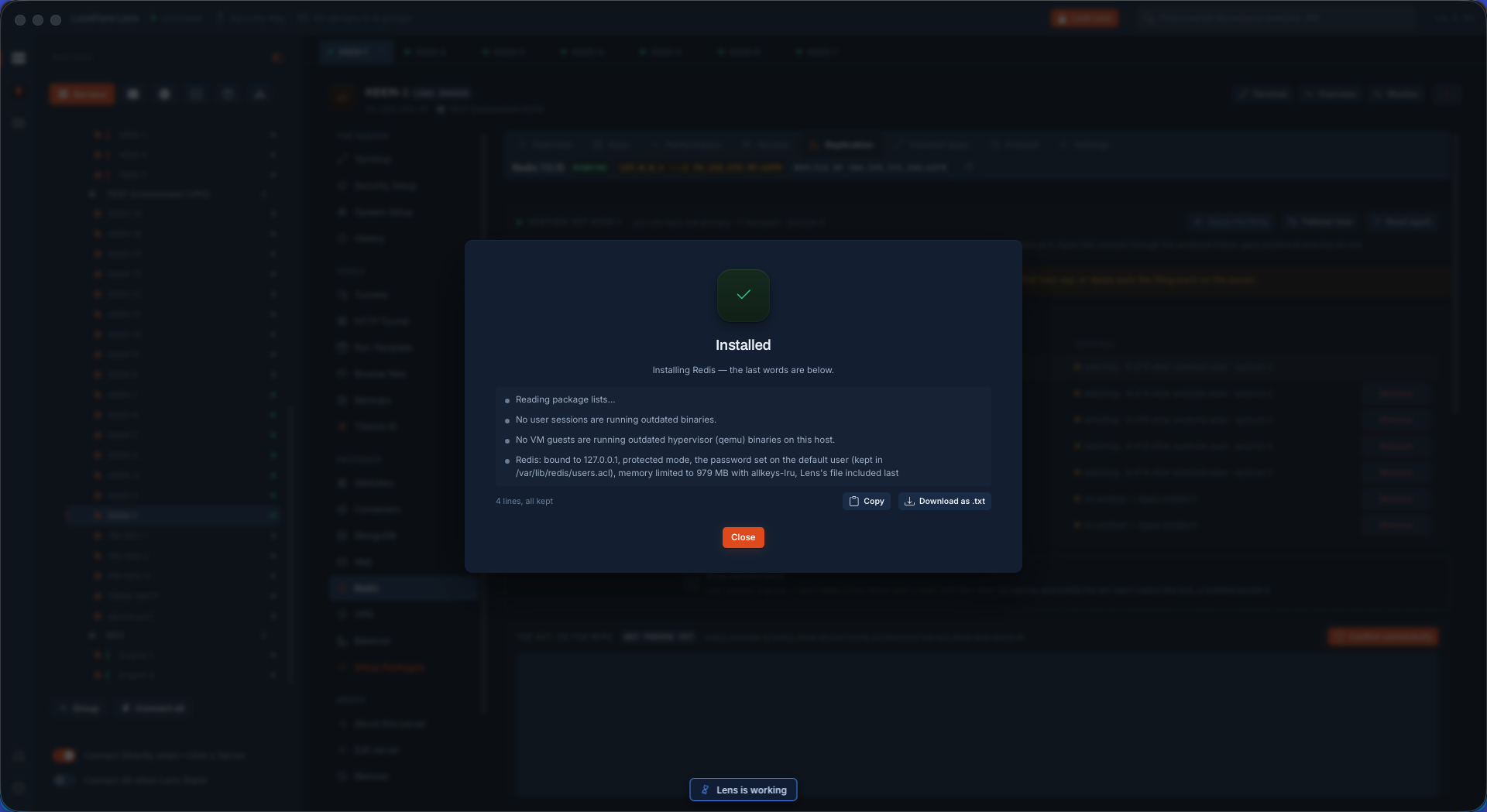
Redis is fast, and famous for being left open to the internet. So the install is not "apt install redis": it is bound to the box, protected mode on, the password you give set on the default user and kept in an ACL file so it survives a restart, memory limited with an eviction policy chosen, and Lens's own file included last so it wins over whatever the distribution shipped. The last line of the job says exactly that, and you can copy or download it.

The screen is honest about what it is doing, too: the install runs on the box on its own and closing Lens does not stop it — but the window stays until it is done, because leaving halfway leaves the box half-changed.
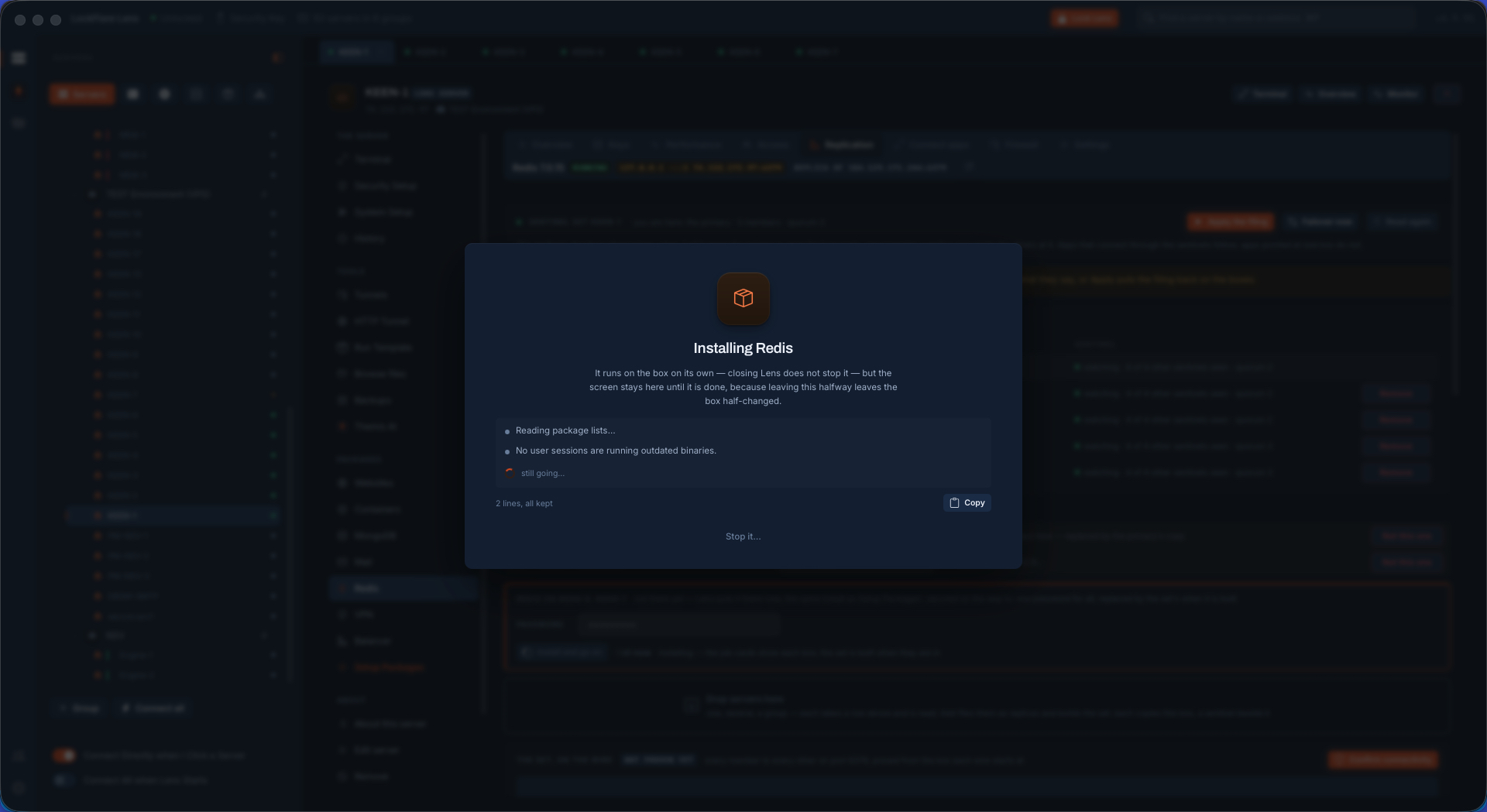
Installing Redis from LockFlare Lens: the job running on the box with its own lines, and a note that leaving halfway leaves the box half-changed
It runs on the box; the window stays until it is done, and says why.
Redis installed: bound to loopback, protected mode, the password on the default user kept in an ACL file, memory limited with allkeys-lru, Lens's file included last
The last line is the whole posture: bound, protected, passworded, limited, Lens's file last.

A Sentinel set, built from drop boxes

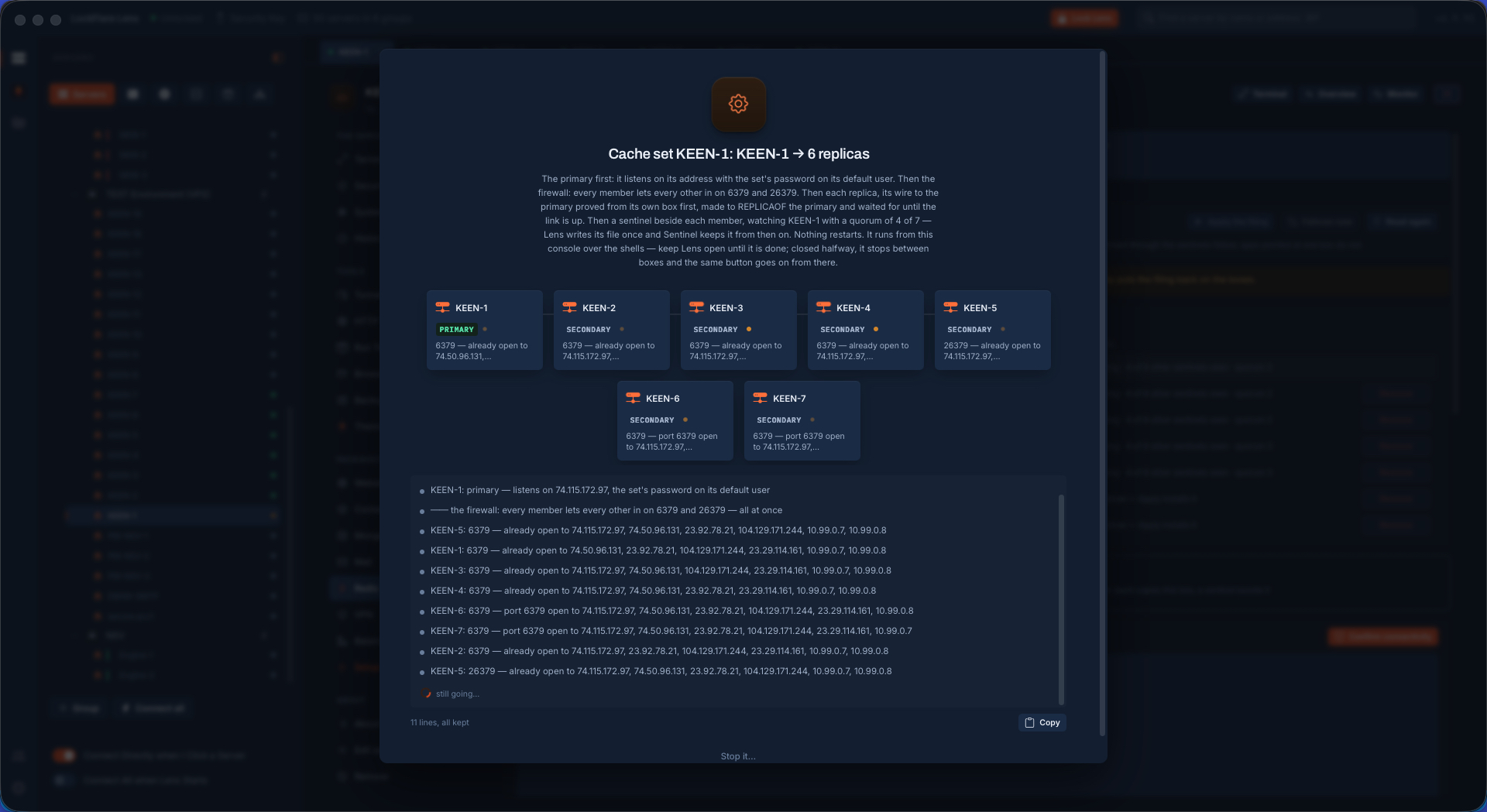
Drop the servers that should copy this one and press Add. What runs then is one job with the order written on it, because the order is the whole trick: the primary first, listening on its address with the set's password on its default user. Then the firewall — every member lets every other in on 6379 and 26379, all at once. Then each replica, its wire to the primary proved from its own box before it is told to follow, then made to replicate and waited for until the link is up. Then a sentinel beside each member, watching the primary with a quorum Lens works out from the count.

Nothing restarts. Lens writes each sentinel's file once and Sentinel owns it from then on. And the same honesty as the install: it runs from this console over the shells, so keep Lens open until it finishes — closed halfway it stops between boxes, and the same button carries on from where it stopped.

Building a Redis Sentinel set in LockFlare Lens: the order of operations written on the job, a card per box, and the firewall opening every member to every other
The order is on the job: primary, firewall, each replica proved then attached, then the sentinels.
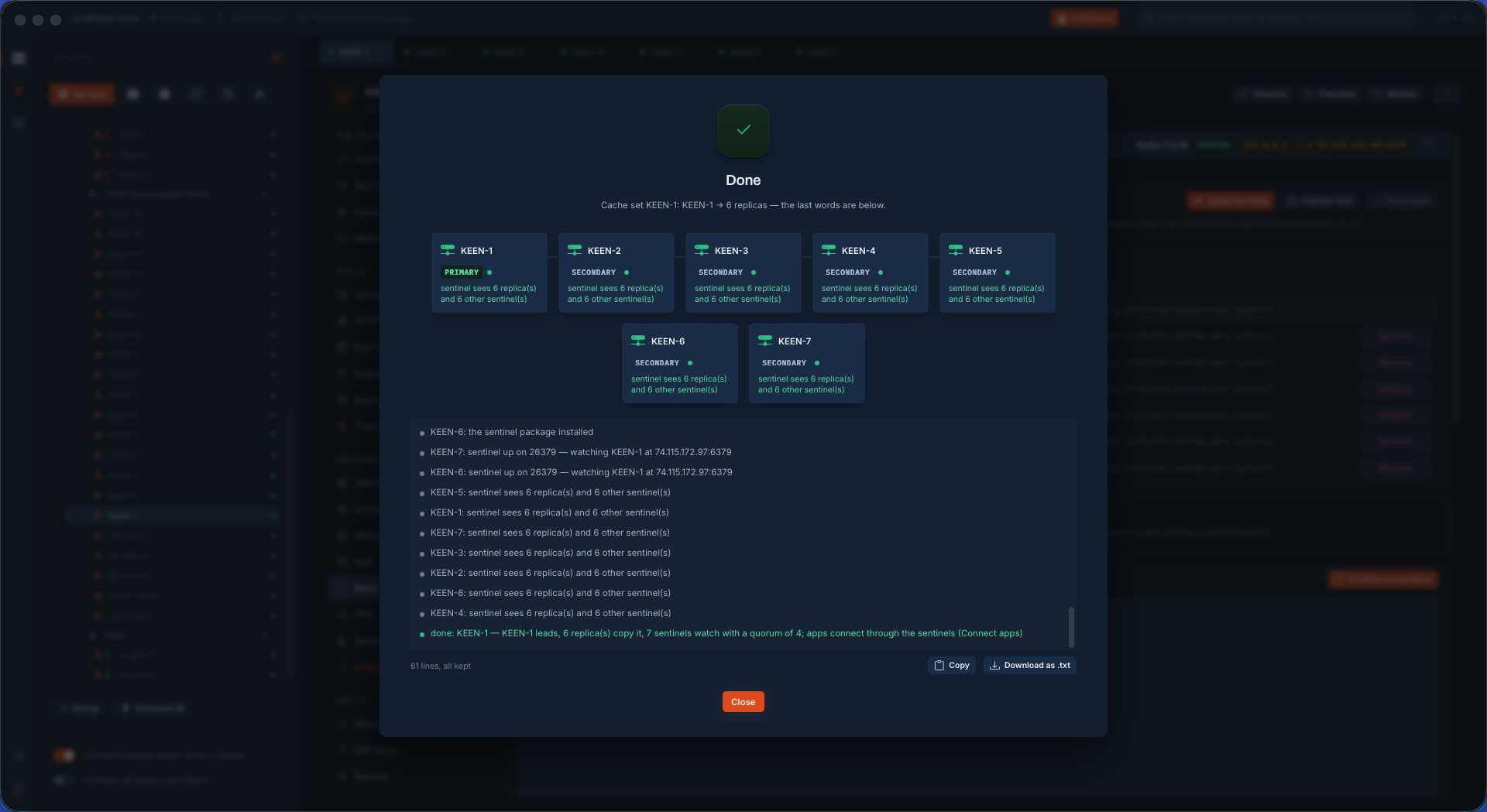
The Sentinel set finished: every member reporting its sentinel sees six replicas and six other sentinels
Done, in its own words: one leads, six copy it, seven sentinels watch with a quorum of four.

Growing it is the same gesture

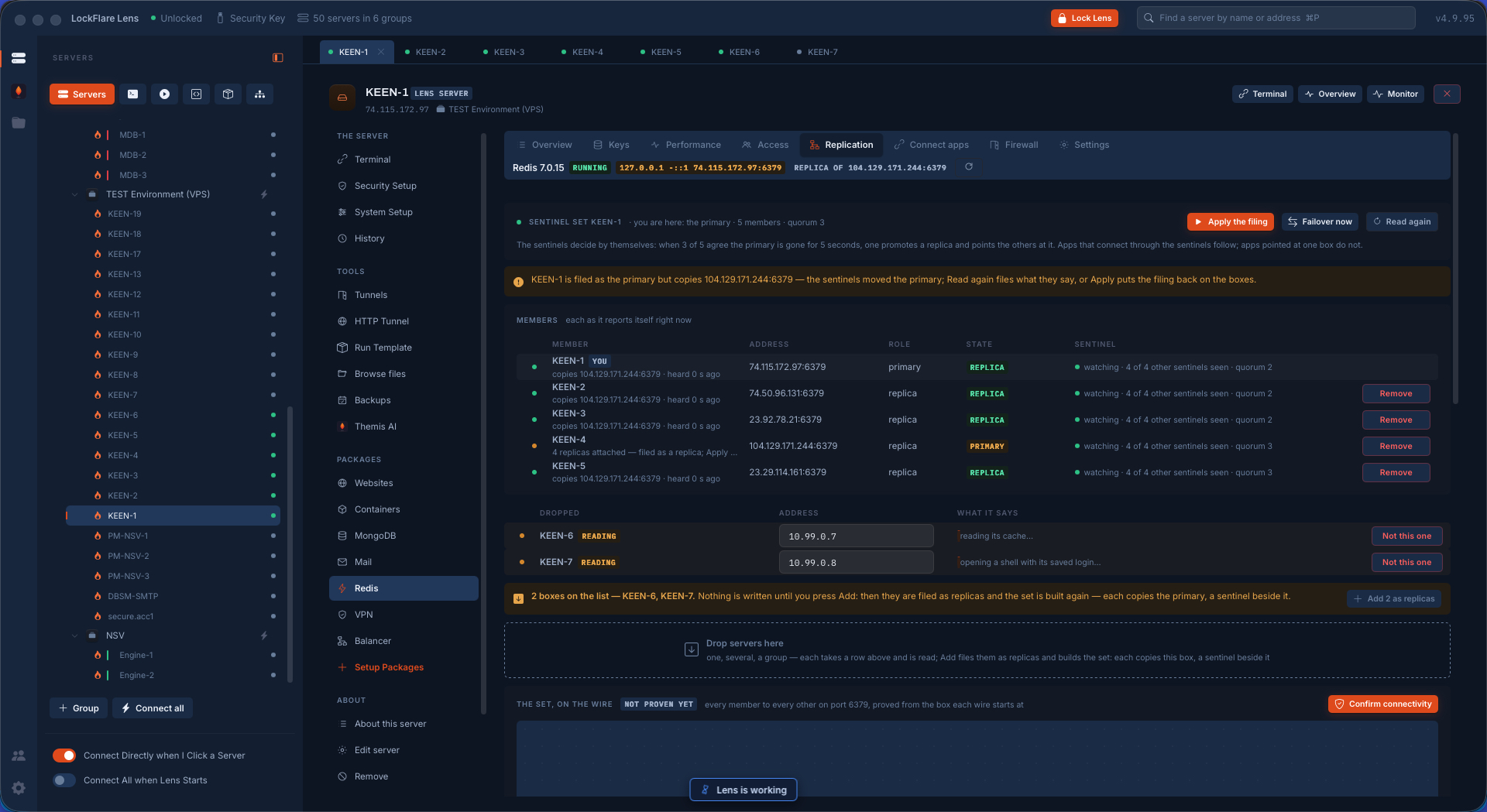
Two more boxes? Drop them on the set. Each takes a row and is read at once — its cache, a shell on its saved login — and if one of them has no Redis, Lens installs it first. Nothing is written until you press Add. Then they are filed as replicas and the set is built again from the top: the firewall opened between every member including the new ones, each new box proved and attached, a sentinel beside each, the quorum recalculated.

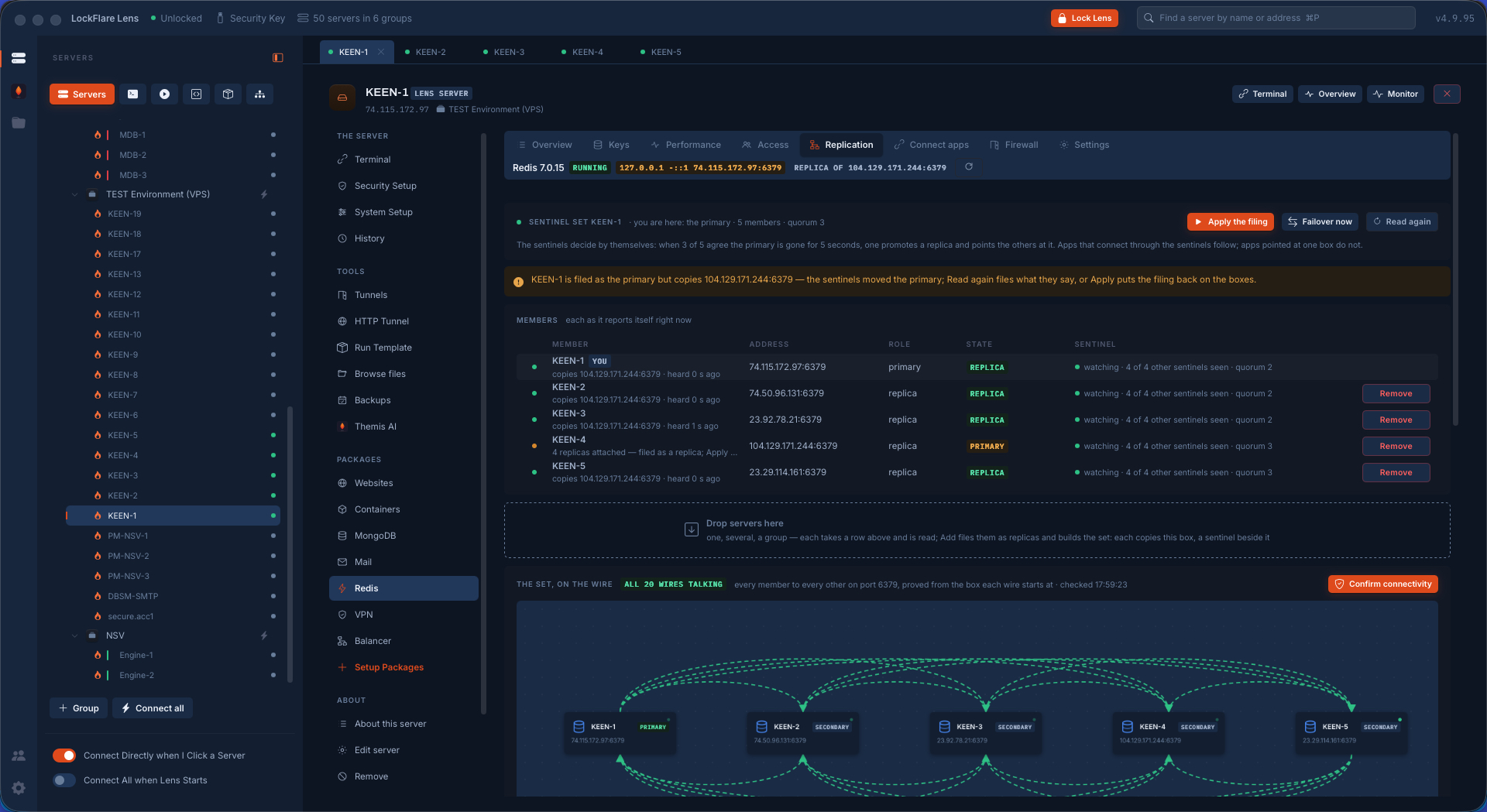
And the wires are re-proved. Five members is twenty wires; seven is forty-two — every member to every other on the port, each one tried from the box it starts at, not guessed from a config file. The header says how many are talking and when it was last checked.

Two servers dropped onto a Redis set in LockFlare Lens, each being read, with nothing written until Add is pressed
Dropped and read — nothing written until Add.
The Redis replication page in LockFlare Lens: every member as it reports itself, the sentinel column, and the set drawn on the wire
Every member as it reports itself — role, state, and what its sentinel can see.

The sentinels decide. Lens writes down what they decided.

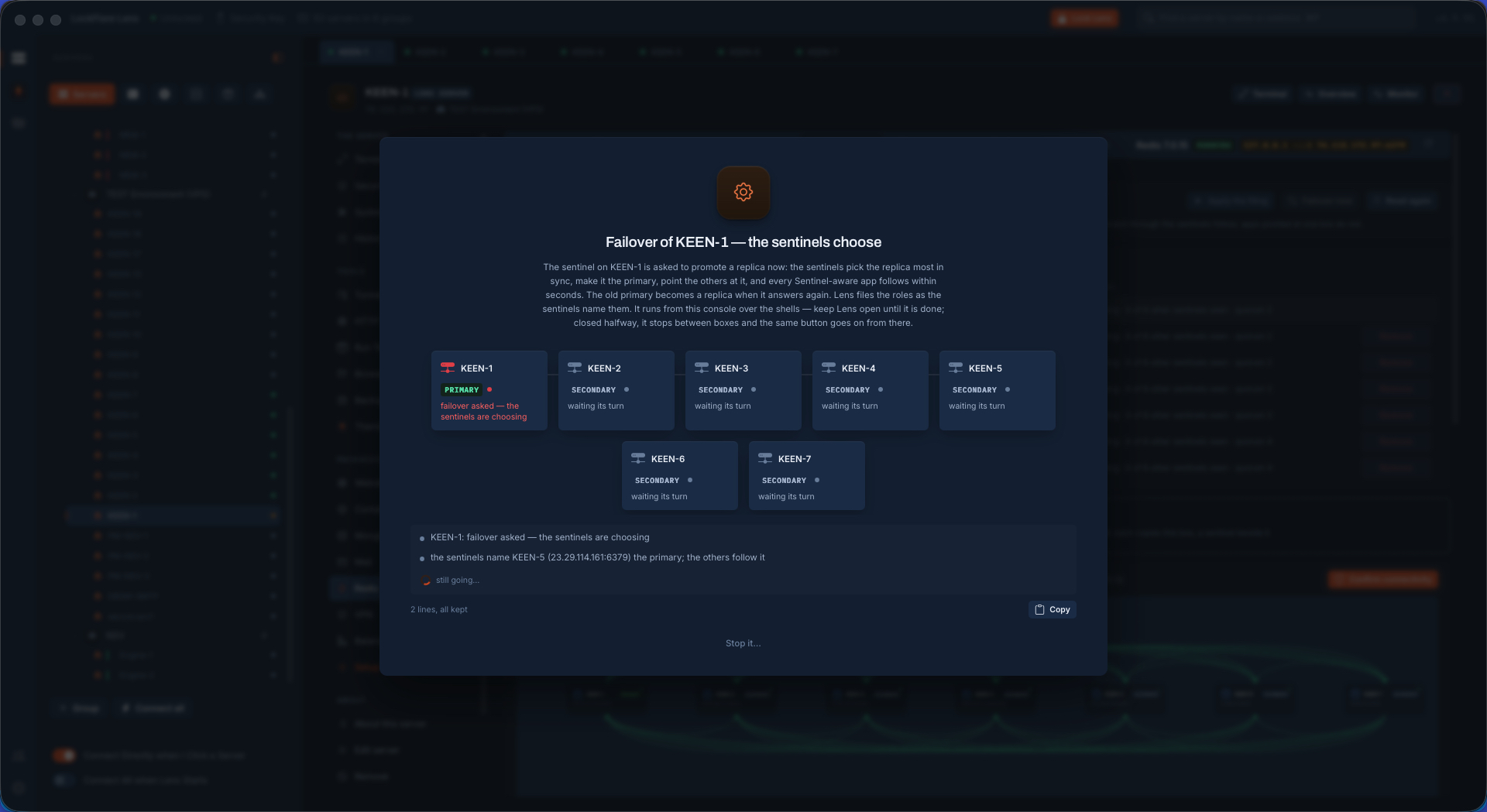
This is the part most tools get wrong by pretending they are in charge. They are not: when enough sentinels agree the primary has been gone for five seconds, they promote the replica most in sync, point the others at it, and Sentinel-aware apps follow within seconds. Failover now simply asks them to do it now — and the log names the box they chose, not the box Lens expected.

Which means the filing on your computer can disagree with reality, and Lens says so instead of hiding it: this box is filed as the primary but copies another one — the sentinels moved it. Read again files what they say, or Apply puts the filing back on the boxes. Two buttons, two honest choices: accept what happened, or put it back deliberately. The old primary becomes a replica the moment it answers again.

A failover in LockFlare Lens: the sentinels are asked to promote now, and the log names the replica they chose as the new primary
Asked, not ordered: the sentinels choose, and the log names the box they picked.

Connect apps: the page a developer actually needs

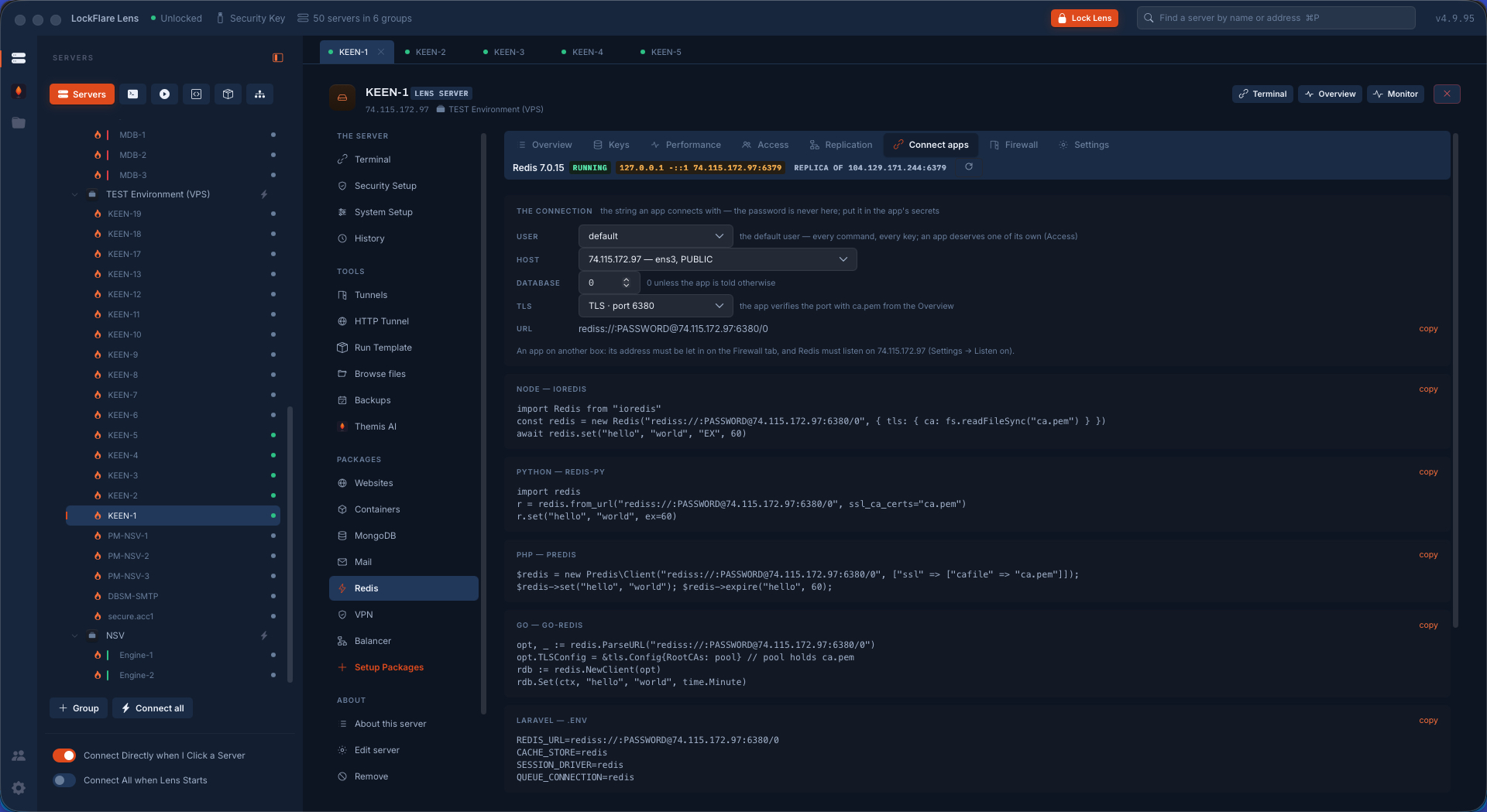
The user, the host, the database number, whether the door speaks TLS — and the connection string built from them, with the password left as a placeholder because it belongs in the app's secrets and not on a screen. Then the same string as working code for the drivers people use: Node with ioredis, Python with redis-py, PHP with Predis, Go with go-redis, and a Laravel .env block. Copy on each.

Two things it tells you that a connection string cannot. That the default user is every command on every key, so an app deserves one of its own — with the door to Access to make it. And that an app on another box needs two things to be true: its address let in on the Firewall tab, and Redis actually listening on that address, not only on loopback.

Connect apps in LockFlare Lens: the connection built from user, host, database and TLS, then the same string as code for ioredis, redis-py, Predis, go-redis and a Laravel .env
Built from the parts, then written out for five drivers — the password left where it belongs.

What it is doing, and what it is set to

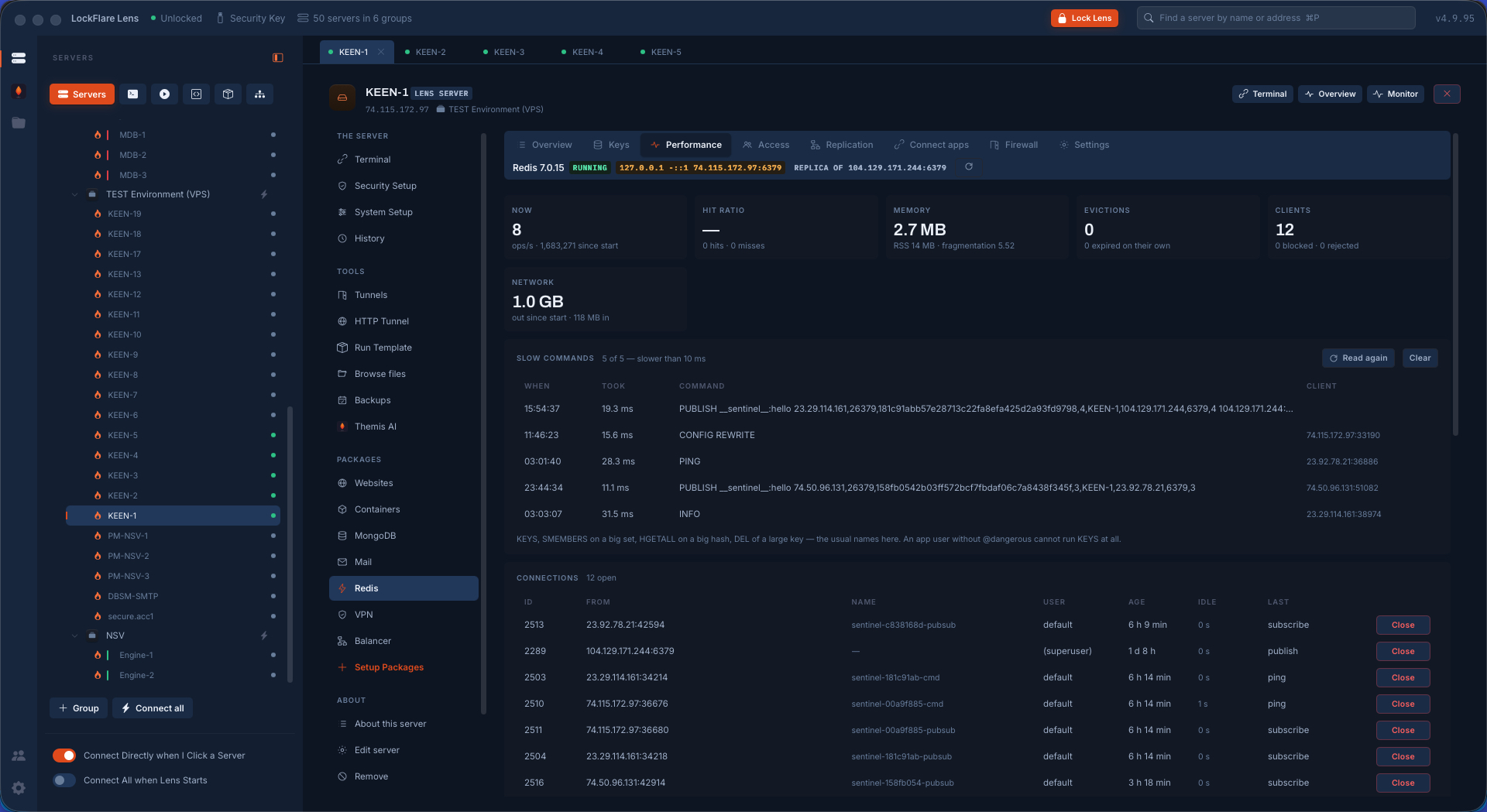
Performance is the numbers that answer a real question: operations per second and the total since start, the hit ratio, memory with its RSS and fragmentation beside it, evictions, clients blocked and rejected, bytes in and out. Under them, the slow commands — when, how long, the command itself and which client sent it — with the sentence that saves an afternoon: the usual names here are the ones that walk everything, and an app user without the dangerous category cannot run them at all. And the open connections, each with what it is doing and a Close beside it.

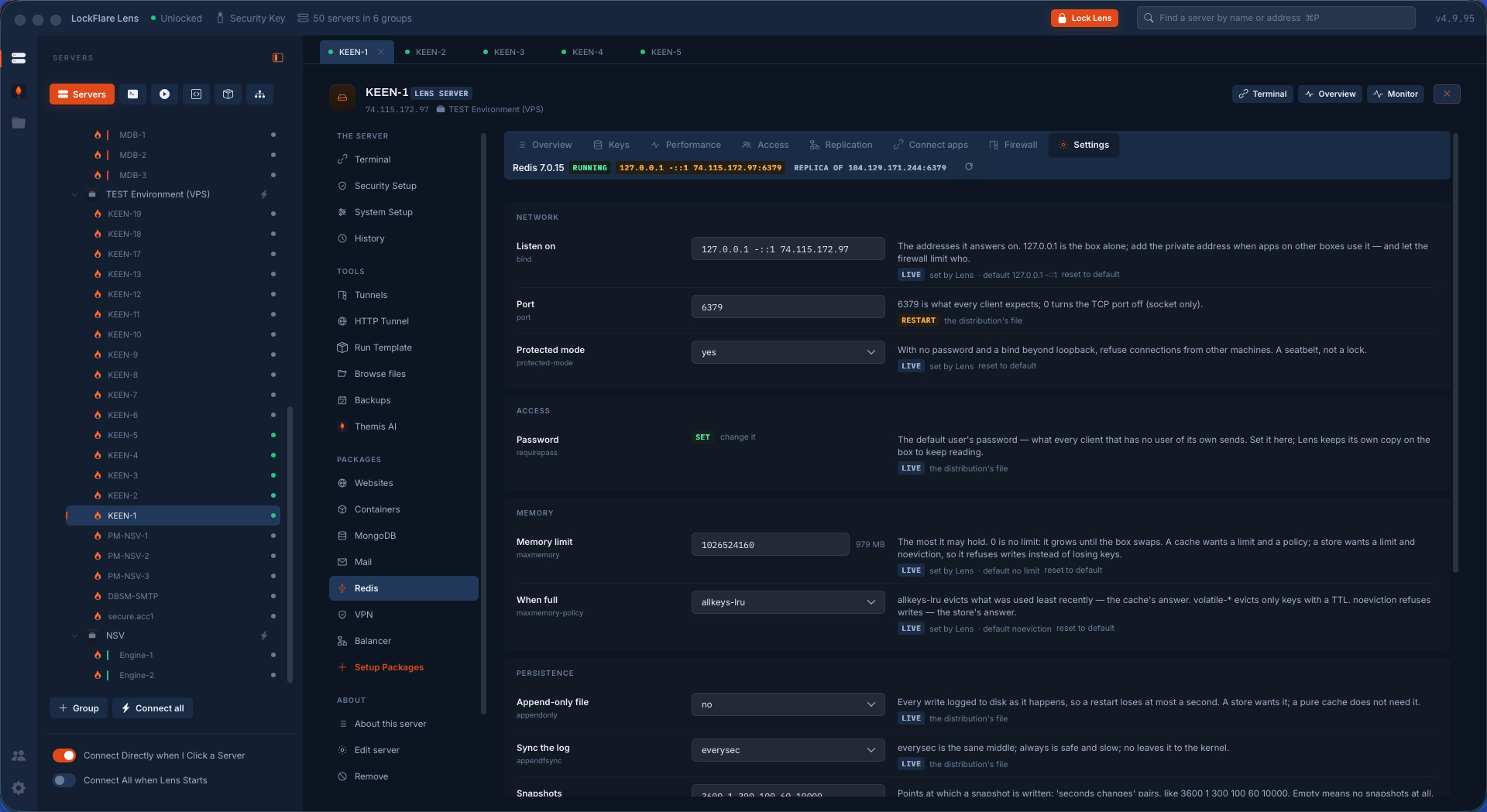
Settings is the configuration as rows in words. What the address means, what protected mode is a seatbelt against, what the eviction policy actually does to your keys, why a cache wants a limit and a store wants durability. Each row says whether the change is live or waits for a restart, whether Lens set it or the distribution did, and offers to put it back to the default.

The Redis performance tab in LockFlare Lens: ops per second, hit ratio, memory, evictions, clients, slow commands and open connections
Slow commands with the client that sent them, and connections you can close.
Redis settings in LockFlare Lens: network, access, memory and persistence as rows explained in words, each marked live or restart-due
Every setting in words, marked live or restart-due, with a way back to the default.

The rest of the tool

Keys

Paged with SCAN rather than KEYS, so browsing a million-key cache does not block it. Open a value, read its TTL, delete one, flush a database.

Access

ACL users with roles that mean something — full, app, reader — kept in a file under the data directory so they survive a restart. The app that only needs GET and SET gets exactly that.

TLS

A second port beside the plain one, with a certificate from the box's own Lens authority, so an app can verify what it is talking to.

Firewall

The engines' firewall view on the cache's ports: who is let in on 6379 and 26379, read from every member and written per node.

Redis or Valkey

Both, the same screens. Whichever the box runs is what the tool talks to.

Not Redis Cluster

Sharding is deliberately not built. Sentinel gives a small fleet the failover it actually needs without the operational weight of a cluster.

The same frame runs your databases

MariaDB, PostgreSQL and MongoDB — explorer, users, backups, performance, replication and sharding — on the rail beside this one.

Databases in Lens